From Paperwork to Patient Care: How AI Is Changing Infusion Operations

Referral intake, benefits verification, and prior authorization eat up hours that should belong to patients. That's the reality across infusion operations today, and it was the starting point for a conversation hosted between Bruce Kutinsky, Pharm.D., CEO of Access Infusion Care, and our Founder and CEO, Joy Liu, on the future of AI in infusion at NICA's Annual Conference (July 9, 2026).
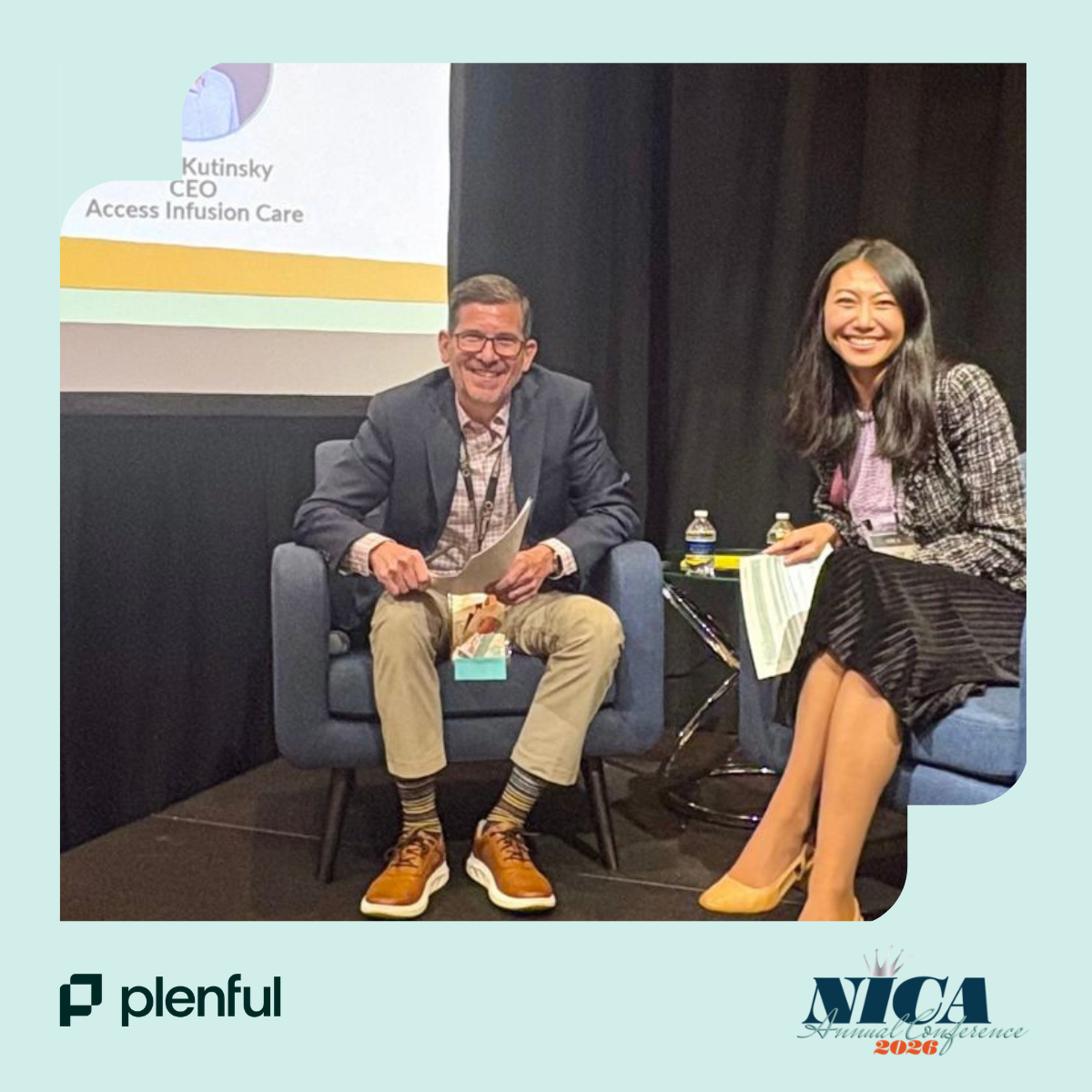
The Shift Away from Paperwork and Back to Patient Care
Bruce has watched referral intake evolve from phone calls and mail to electronic systems, each step making information arrive a little faster. AI keeps that curve going, but changes what "faster" actually means. Instead of one person reading every page in sequence, AI gathers and reasons across disconnected systems at once, and does it with more speed, more completeness, and more accuracy than a person working through the same stack of documents alone.
"Plenful's AI platform shifts our staff's focus from paperwork to the person."
— Bruce Kutinsky, CEO, Access Infusion Care
Instead of hours sorting documents, teams get that time back to spend with the patient in front of them—the reason many got into the field in the first place.
Analyzing Data, Not Just Moving It
When Access Infusion Care first explored AI, Bruce had two specific problems he wanted to solve. The first was simple: get his team focused on patients instead of paperwork. The second came out of a comprehensive payor audit, the kind that requires reconstructing years of documentation across multiple systems by hand. It led him to a question worth sitting with: could every referral become an audit-ready file from the day it comes in, instead of something rebuilt under pressure months later?
What surprised him came after implementation. He expected AI to simply move information between systems, only faster.
"The real breakthrough was realizing that AI could reason and analyze information, not just move it between systems."
— Bruce Kutinsky
Infusion teams sit on mountains of disparate clinical, operational, and financial data. The gap was never collection. It was integration, orchestration, and the ability to turn that data into action, connecting the dots and automating repeatable, trainable decisions so the process moves forward without someone picking up the phone or typing in data from a fax. It's exactly why we built our Intake Authorization Management Suite, to turn disparate data and tedious tasks into an automated workflow.
Turning that into practice with Access Infusion Care started with understanding how their team thinks about incoming documents. Every organization has its own workflows and conventions for categorizing referrals, and those nuances are critical for automation to work seamlessly.
Rather than asking Access to change their process, we partnered closely with their coordinators to learn how they already reviewed and classified documents. Those real-world insights helped us tailor our models to match their workflows, ensuring the technology adapted to the people using it—not the other way around.
Before automating anything, we spent time with the coordinators to understand where their day was actually spent, not where we assumed it was. That distinction mattered. It helped us identify which steps could be automated confidently and which still benefited from human judgment. Once information is extracted, classified, and approved, it's automatically uploaded to the patient's record. Because Plenful identifies patients at the very beginning of the intake process, new and existing referrals are intelligently routed to the appropriate clinical team from the start—eliminating manual triage and accelerating time to care.
Institutional Knowledge Shouldn't Live on a Post-It
Walk into most infusion centers and you'll find institutional knowledge living everywhere except where it should: a sticky note flagging a payor's documentation quirk, a word document tracking preferred drugs, a spreadsheet documenting approval status, and historical context living in one coordinator's head. None of it lives in one shared place that everyone can access. On any given day, no one has the full picture without checking four different spots first. And if that coordinator leaves, years of institutional knowledge leave with them.
It matters even more in the rural and underserved markets Access Infusion Care serves, where patients want to connect with a real person who understands their community and treats them like a human. Recruiting deeply specialized intake staff in those markets is a challenge. AI can't replace a human connection. Instead, AI is best incorporated behind the scenes. It does the manual, tedious work that prevents care teams from serving their patients. In Bruce’s words, success is when "when AI enables my team to become patient navigators instead of paperwork processors."
Keeping Clinicians in Control
On where the human stays in charge, Bruce didn't hedge: for today, clinical decisions stay with clinicians. He compared it to his Tesla — plenty capable, but not something he trusts to drive itself unsupervised (yet). AI's value shows up before the decision gets made, pulling together lab values, physician notes, formulary optimization recommendations, and authorization status so a pharmacist isn't hunting across five systems before they can even start thinking clinically.
Joy sees this as a data opportunity as much as a workflow one:
"The real value isn't simply completing those workflows. It's the data generated along the way."
— Joy Liu, Founder & CEO, Plenful
Once workflows like referral intake and benefit investigation become standardized and digitized, that data can do things it couldn't before: keep records synchronized across systems automatically, generate audit trails as a byproduct of the work instead of something reconstructed after the fact, and give infusion organizations real leverage in payor contracting conversations that used to run on guesswork.
Getting there takes standardized, digitized workflows first. Most infusion organizations today, in Joy's view, are still closer to the early end of that journey: some alerts, some workflow automation, not yet a system that intelligently assembles information across sources on its own.
What the Data Shows
For infusion teams further along, the numbers back this up. Customers using Plenful for intake and prior authorization have seen more than a 75% reduction in manual administrative effort.
One of our partners, a Chief Technology Officer at a leading national specialty and infusion pharmacy, described a smaller but telling shift: before automation, tracking where a referral stood in the workflow meant manually updating a status field inside their pharmacy management system. Now, most of that reporting happens on its own, and that visibility changes staffing and process decisions from guesswork into something backed by data.
Bruce's Advice: Don't Be Afraid to Embrace AI
Bruce's advice to anyone still on the fence was straightforward: don't be afraid. Implementing new technology isn't easy, and neither is changing a workflow people already know. But what's missing from most AI conversations is the patient. Most stay focused on efficiency and labor. What matters more is whether patients start therapy sooner, and whether pharmacists and technicians get to spend their time practicing pharmacy instead of hunting for information. Technology isn't the goal. Better patient care is.
To learn more, explore AI solutions for infusion teams, and check out our coverage in Becker’s Hospital Review.

.png)


.png)