Institutional Memory: How Plenful’s AI Learns From Your Best Pharmacists to Scale Capacity


You just hired a new pharmacy team member, and you want them up and running ASAP. But where do your best practices, rulebooks and guardrails actually live? Maybe your most experienced pharmacy employee knows most of it, but do they have the time to sit and mentor all your future hires? And how about every time a policy change goes into effect? Or when someone quits?
Clinical guidelines, drug formulary selections, practice standards, and regulatory compliance are all changing constantly. Communication is sent to the team but adoption and application of these changes 100% of the time is nearly impossible. This is compounded by turnover rates and labor shortages in pharmacy.
The answer is Institutional Memory
The answer to this problem is Institutional Memory. One curated memory for your institution, a single place where your best practices live, stay current, and are available to every person and every member of your team.
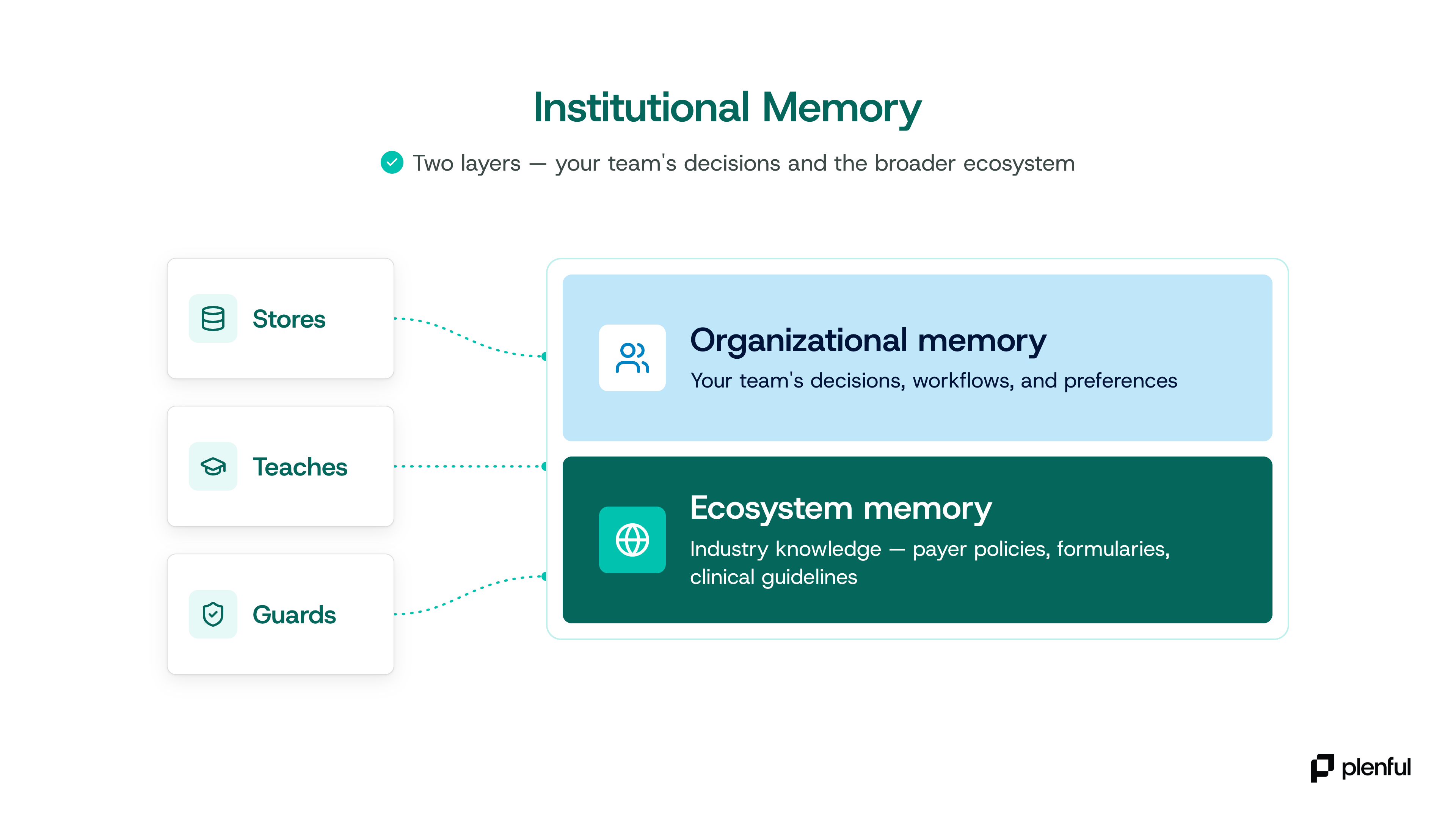
Institutional Memory has two layers:
- Organizational Memory is yours: your team's decisions, workflows and preferences, recorded as your team works.
- Ecosystem Memory is the industry knowledge that Plenful brings to every customer: like payer policies, formularies and clinical guidelines. Together, they do more than store. Memory teaches our agents what to do and guards against actions that don't align with how your team works.
Institutional Memory powers Plenful’s Agents
Our agents use customized harnesses built on best-in-class models and Institutional Memory to deliver specialized workflows for pharmacy and infusion teams. This is how Plenful automates complex work like selecting the preferred formulary agent, optimizing the site of care through Deep Benefit Investigation (DBI) or improving Prior Authorization workflow.
However, what your organization knows this week, like the payor rule that changed on Tuesday or the drug shortage that occurred this morning, moves far too fast to be trained into any model. Without memory, running an agent is like onboarding a new pharmacist, with no one around to train them. That’s why we built Plenful’s AI Platform around Institutional Memory: every case your team works makes the platform smarter, and everything it learns stays specific to your practice.
Your team and our agents learn from the same memory
Your team and Plenful’s agents work on top of the same Institutional Memory. Both have the same context and reason over the same objects, so when your best team member corrects an agent, that correction, once approved, lands exactly where every agent will find it next time. Every case shows which memories shaped it, so you can always review the evidence and confirm why the agent made a decision.
This builds a trust loop: your team reviews, our agents learn their preferences, and with every loop the reviews get faster.
The result: 4x greater team capacity, 75% less admin work and faster time to therapy for patients.
"Since partnering with Plenful, our team's capacity has grown 4x, allowing us to focus on patient care instead of drowning in paperwork." — Chief Technology Officer, leading national specialty & infusion pharmacy
Consider a typical scenario where a pharmacy team member aims to fill a specialty prescription
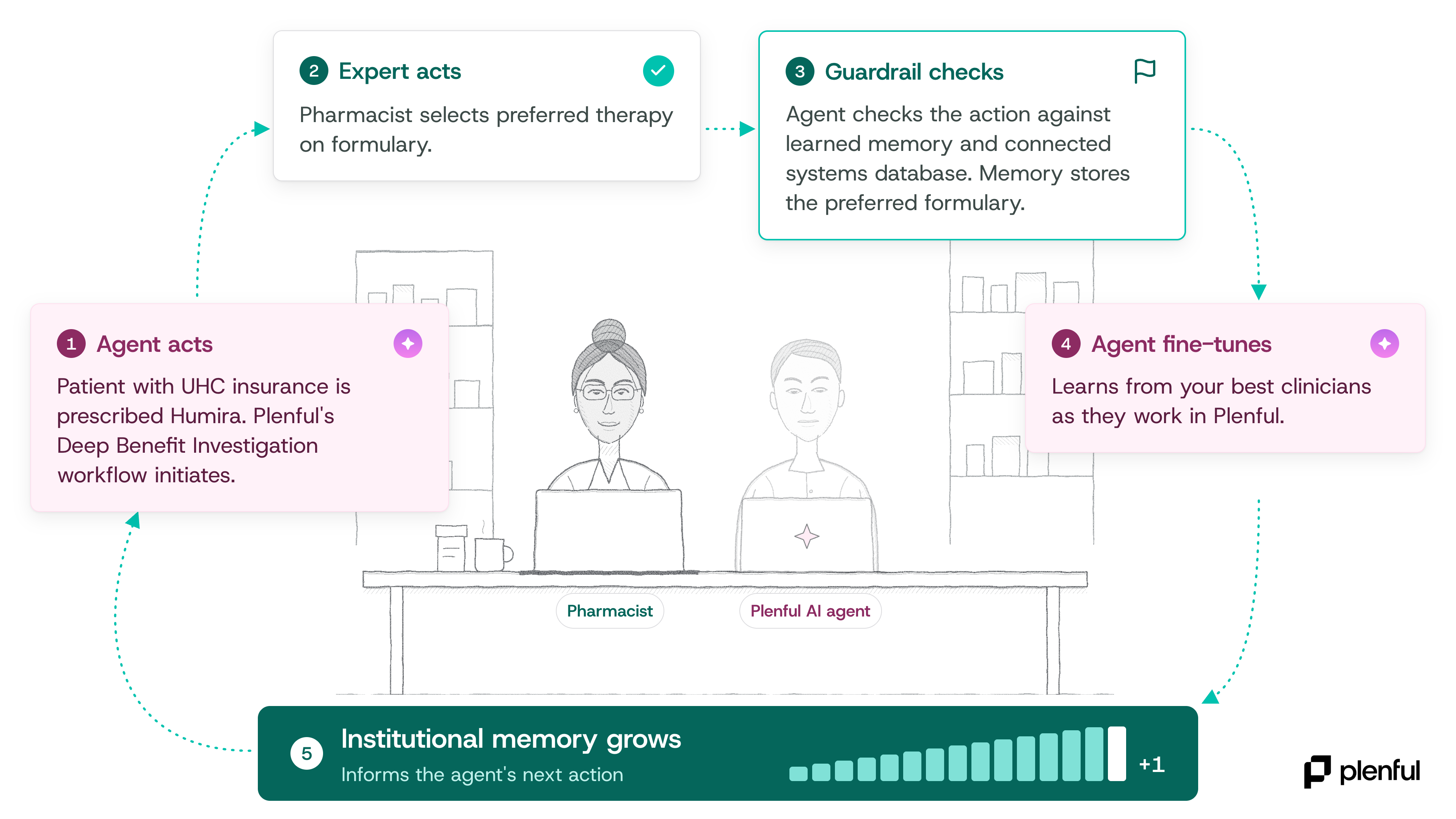
Let’s walk through an example: a specialty prescription for Humira arrives for a patient covered by UnitedHealthcare (UHC). UHC omits Humira from its formulary, steering members toward two biosimilar alternatives, Amjevita or unbranded Hyrimoz.
Though clinically comparable, these options differ in acquisition cost, reimbursement, speed to therapy and patient copays. Pharmacies naturally maintain distinct preferences tied to their inventory, margin profile, and patient costs. Balancing these shifting factors across countless payers makes flawless execution difficult, which is precisely why capturing your organizational preferences in memory matters.
When this prescription comes in, our agents pinpoint the opportunity during Deep Benefit Investigation and apply your stored preferences to route to the ideal option. Should a variable like drug cost shift, your staff simply selects the updated choice, and our agents capture it as a proposed memory, ensuring every subsequent case defaults to the right path upon approval. And if a pharmacist picks a different product for one patient for a clinical reason, our agents recognize it as a one-off and leave your preference as is.
Six months down the line, if UHC updates its formulary guidelines:
Memory detects two conflicting rules, prompting our agents to highlight both for your staff expert alongside their origin and timestamp. The staff expert validates the latest requirement, the obsolete rule is retired, and your team continues selecting the optimal therapy seamlessly.
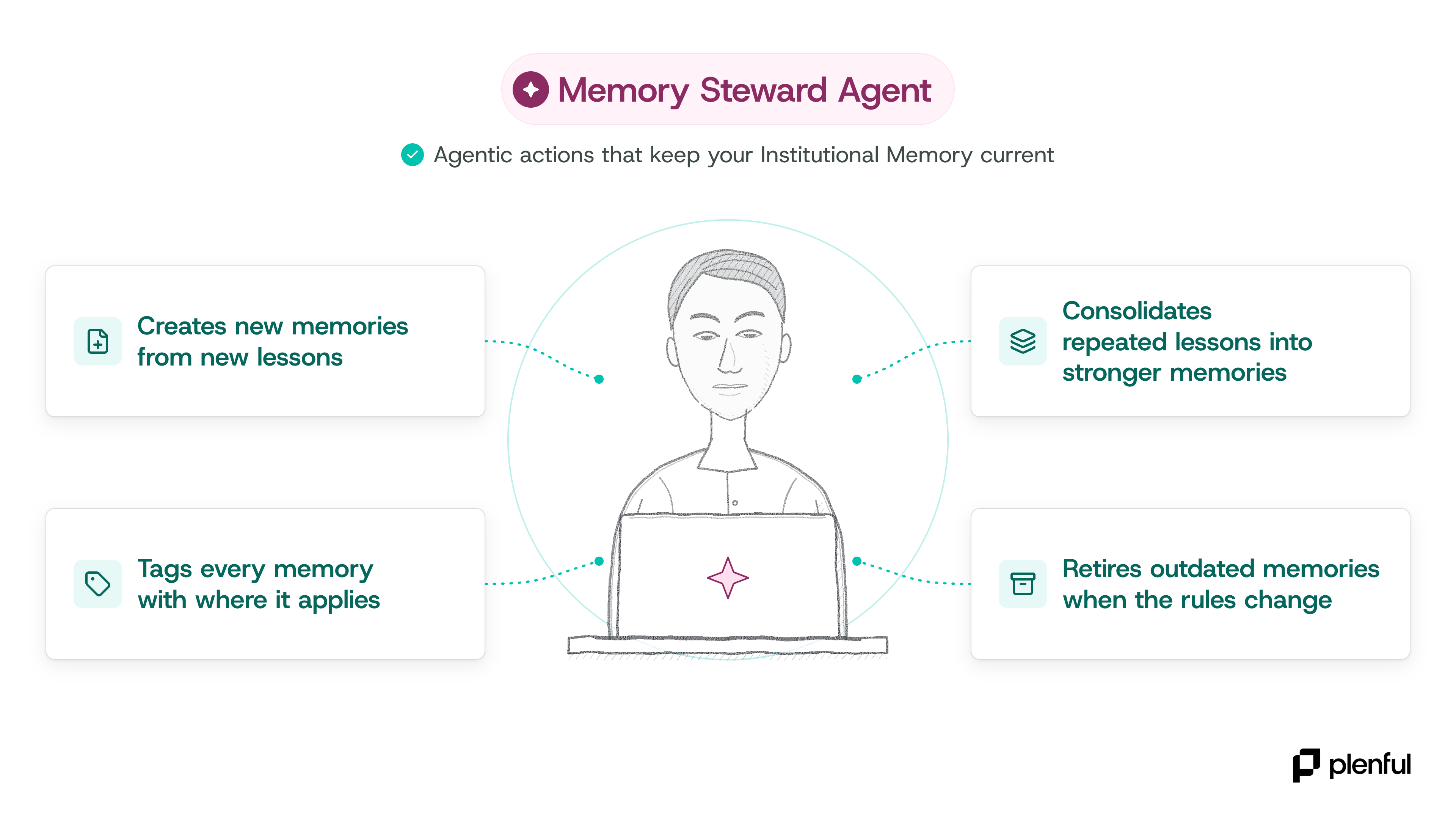
Meet the Memory Steward: four agentic actions that keep your memory current
Plenful's agents reason over something far richer: every prior authorization, denial, request for information and correction your team makes is a lesson. The Memory Steward is the agent that turns those lessons into Institutional Memory. Like your best pharmacist, it works out what happened, why it mattered and where else it applies, running these agentic actions:
- Creates new memories from new lessons. When a case teaches something new, the Memory Steward drafts a memory for it. If it looks like a one-off, like an exception for a single patient, it flags it so your experts can decide whether to keep it.
- Tags every memory with where it applies. A biosimilar preference for UHC adalimumab cases activates only on those cases.
- Consolidates repeated lessons into stronger memories. When the same lesson shows up again, the Memory Steward reinforces the existing memory and records the source. When two memories conflict, it compares where each came from, who approved it and how recent it is, then asks your experts which should apply.
- Retires outdated memories when the rules change. When UHC updates its formulary, the Memory Steward retires the old rule once your experts approve the new one. Agents only ever work from the current version.
Nothing is automatic. Your experts review every change, so your memory reflects the standards your team sets.
Memory works like your best pharmacist's brain, it keeps what matters and retires what doesn't
Given how well it's served our kind, we heavily drew on the human brain for the architecture of Institutional Memory.
The human brain manages a lifetime of memories within a constant 20-watt power envelope. Our human memory is split into episodic, what happened in a day, and semantic, the core concepts the brain develops over time. Almost every drive to work is an episode that's gone by lunch, but the morning Main Street was closed and you walked into your meeting 20 minutes late sticks, and becomes a concept - avoid Main Street before 9:00a.
The brain only promotes episodes with significance, and it tags each concept with context, and crucially it retires irrelevant memories to maximize space. So the Main Street rule lights up on a weekday morning, stays dark on a Sunday grocery run, and quietly retires the week the road reopens. All of this happens while we sleep, with some evidence that dreaming is the replay this consolidation requires.
I have been obsessed with this idea for over a decade. In my thesis at Virginia Tech, I proposed the Dream Architecture for Lateral Intelligence (DALI), a system that uses a dream phase to reorganize its knowledge offline, keeping real time performance constant even as that knowledge grows. Back then, the DALI was reasoning over a 220-word speech vocabulary on mobile hardware, with models even GPT-2 would beat.
Pharmacy is just the beginning
Plenful was born within the four walls of pharmacy, but we’re building the Institutional Memory for healthcare. The more workflows we power from patient intake, to benefit investigation, to prior authorization, and more, the richer your Institutional Memory becomes, enabling your organization to scale both sustainably and securely.
We’re seeing incredible results across our customer base. Elevance Health, who provides one of the largest infusion service networks in the United States, reports 60%+ efficiency gains across infusion intake authorization workflows since going live with Plenful.
“Plenful has delivered 60%+ efficiency gains across our intake authorization workflows, and we’re excited to continue expanding the partnership” — Tom Greinert, Staff VP, Infusion Dispensing Ops, Elevance Health
If you want your pharmacy running at the cutting edge of the agentic revolution, request a demo to connect 1-1 with our team. If you want to help build it, check out our careers page.
Stay tuned for our next post, where I'll open up how our agents test every memory before it ever reaches your staff.